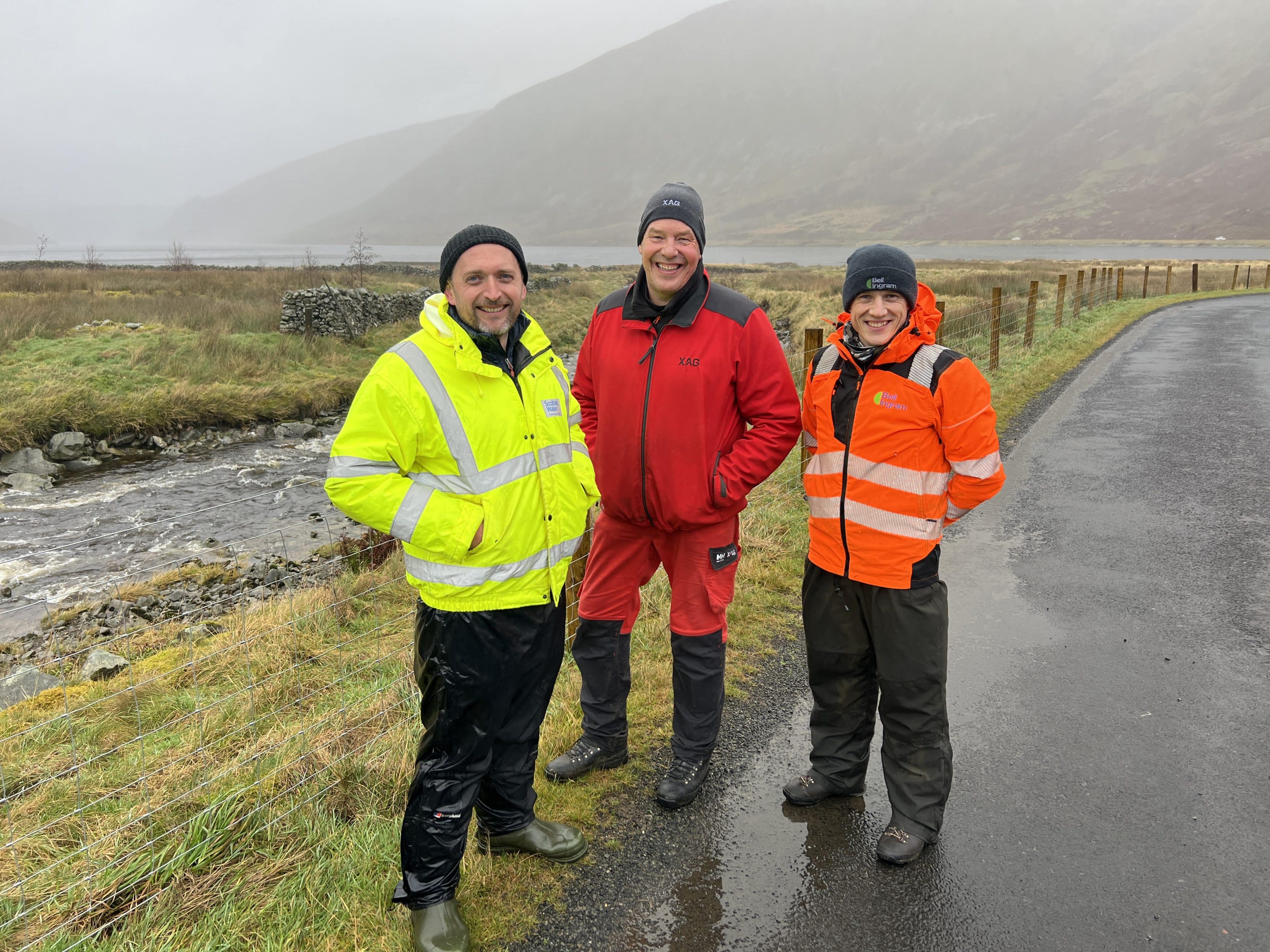
A groundbreaking woodland creation project in the Scottish Borders has seen advanced drone technology deployed to seed over two million native trees across inaccessible upland areas.
For the first time in the UK, heavy lift drones have been licensed to operate to beyond the line of sight while dispersing pelleted tree seeds in remote areas in the hills surrounding Talla Reservoir as part of a Scottish Water project to help protect water quality at the site.
Forming part of an envisaged 80-hectare woodland creation scheme on land surrounding the reservoir, the first drone seeding phase focused on a 20-hectare area where the publicly-owned utility company hopes to enrich existing woodland across the upper slopes of the catchment.
Working with delivery partner Bell Ingram and stakeholders, proposals for the Talla Water Woods project could additionally see thousands of native broadleaves such as aspen, rowan, oak, alder and downy birch planted at the site towards the south eastern end of the reservoir, as well as establishing montane woodland in the higher altitude areas of the site.
The aim is to help stabilise the soil surrounding the reservoir so that less organic matter is washed into the water during periods of extreme rainfall which are increasing in frequency due to climate change. This will make the treatment process simpler and less energy intensive.
Woodland creation programme manager at Scottish Water, Stephen Garbett, said: “This is a completely innovative approach to woodland creation and we are really excited to be working with Bell Ingram and AutoSpray Systems to make use of this cutting edge technology at Talla Reservoir.
“The nature of the landscape here means that traditional methods of tree planting would be extremely difficult and time consuming to carry out so to be able to harness this drone technology to effectively open up areas of the site like this is great. We are looking forward to seeing the results now that the first phase of drone seeding has been completed.”
Climate Action Secretary Gillian Martin said: “Our forests and woodlands are a natural powerhouse, and one of the most important resources we have to tackle the climate and nature emergencies. I welcome this initiative from Scottish Water which will help to create new woodland – helping to increase local biodiversity, whilst creating a natural way to reduce flooding in the area.”
Sam Guthrie, Forest Manager at Bell Ingram said: “This pioneering project involves planting 2.1 million native tree seeds using novel drone and seed pelletisation technology, supporting Scottish Water’s net zero ambitions and woodland creation goals.
“We are proud to deliver Scotland’s first drone-sown upland native woodland with approval to operate a drone ‘Beyond Visual Line of Sight’, combining cutting-edge innovation with best-practice forestry and strong environmental stewardship.
“Through projects like Talla Water Woods, the team is setting new standards for sustainable woodland creation, maximising outcomes for both climate and client.”
Industry leading drone company AutoSpray Systems carried out the work. CEO Rob Pearson said: “We at AutoSpray Systems are excited and proud to be delivering this project with Scottish Water. It’s a pioneering operation, harnessing drone technology to sow 2.1 million native seeds on challenging terrain, a significant step forward for the UK forestry sector.
“We hope the woodland will be a powerful demonstration of how innovation and technology can be harnessed to support conservation and environmental projects.”
The Talla project builds on the back of other local initiatives such as Talla and Gameshope to the south of the reservoir owned by the Borders Forest Trust, helping to link up habitats and create wildlife corridors as part of the Wild Heart Expansion Project, which has significant benefits for biodiversity.
A total of 55 hectares of the scheme could be made up of montane woodland, making it one of the largest montane schemes in the Southern Uplands. The important habitat has almost vanished in Scotland due to grazing by red deer and sheep and will have a positive impact on biodiversity and flood mitigation in the area.
The Road to Net Zero: What it means for farmers and landowners
by Rhona Booth, Senior Associate
In an era defined by the urgent need to address climate change, the UK and Scottish Governments have emerged as global leaders in the race towards a sustainable future. With a commitment to environmental responsibility, both governments have set ambitious Net Zero targets signalling a transformative shift towards a low-carbon, resilient economy.
In Scotland, farmers and landowners hold the key to delivering many of the sector targets, specifically around carbon offsetting, sustainable farming practices, afforestation projects and initiatives to enhance biodiversity.
The Scottish Government also continues to invest in and promote the development of renewable energy projects, aiming to generate a substantial portion of the country’s energy from clean sources.
In this article I explore the financial opportunities around the strategies and initiatives employed by the Scottish Government to fulfil its commitments to achieving Net Zero.
Solar Power: One of the most promising avenues for landowners is the integration of solar energy into the national grid. Scotland’s government has been actively encouraging the adoption of renewable energy, and solar power is no exception.
Developers are actively pursuing solar opportunities across Scotland with hotspots on the East Coast where irradiance levels are highest. Bell Ingram are acting for numerous land owners, negotiating exclusivity agreements, Heads of Terms and assisting landowners and their legal advisors during the option and lease process. Lease terms are typically 40 years with rentals significantly greater than those generated from agriculture making hosting a solar development and attractive proposition. Bell Ingram will negotiate the best deal with our knowledge of the market and expertise on practical matters of development. The developer will meet the cost of professional fees. Although the connection date to the grid can be up to a decade away due to the constraints on the electricity network, developers are keen to secure land at the present time via an option agreement.
Battery Storage: While solar (and wind power) are integral to the renewable energy landscape, they come with inherent challenges related to intermittency and grid stability. This is where battery storage systems play a crucial role. By storing excess energy generated during peak times and releasing it when demand is high, battery storage helps balance the grid, ensuring a reliable and stable power supply.
Landowners can enter into lease agreements with energy developers for the use of their land to host battery storage facilities. These agreements typically involve regular rental payments, providing a steady income stream for landowners without requiring active involvement in the day-to-day operations.
The land take for battery storage is relatively small, four to 20 acres making this opportunity as an addition to the farming business and income stream. The proximity of a substation is a prerequisite to hosting a battery storage scheme.
Carbon Off Setting: The financial opportunities for landowners in the realm of carbon offsetting, particularly through woodland creation schemes, are vast. However, it is essential for stakeholders to approach this market with a commitment to sustainability and ethical practices. By carefully navigating the complexities of acquisition, market dynamics, and ecological considerations, landowners can play a pivotal role in combatting climate change while reaping the financial rewards of responsible carbon offset initiatives.
Electricity Infrastructure: SSE’s massive £10 billion investment in electricity infrastructure is geared towards enhancing and expanding Scotland’s electricity infrastructure. This includes the development of renewable energy projects, grid upgrades, and the deployment of cutting-edge technology. Landowners situated in proximity to these projects stand to benefit significantly.
One of the primary opportunities lies in leasing land for renewable energy projects such as wind farms or solar installations. SSE’s commitment to increasing renewable capacity provides an ideal environment for landowners to generate steady income through long-term leases.
Beyond renewable energy projects, SSE’s investment includes significant upgrades to the electricity grid. It is important for landowners to engage early with SSE to ensure that their views are taken into account as far as possible in the design of the scheme. New pylons are the unfortunate requirement to secure renewable opportunities across the country and SSE and the Scottish Government has strong statutory powers the roll out their infrastructure programme.
Low-Carbon Hydrogen Economy: The Acorn Project, based in North East Scotland, is a groundbreaking initiative that aims to deliver low-carbon energy solutions. At its core, the project focuses on repurposing existing oil and gas infrastructure to support the development of a low-carbon hydrogen economy.
One crucial aspect of the Acorn Project is the need for gas transportation to the St Fergus terminal and those landowners situated along the gas transportation route to St Fergus have a unique chance to play a crucial role in this transformative journey. By exploring servitude agreements, lease arrangements, and actively participating in community development, it is envisaged that landowners can maximise the financial benefits while contributing to a more sustainable and resilient energy future.
Top Tips:
-
While the financial opportunities are abundant, it is crucial for landowners to navigate the regulatory landscape effectively.
-
Understanding planning permissions, environmental impact assessments, and community engagement requirements is essential for a successful partnership with energy infrastructure developers.
-
Seeking professional advice can help landowners make informed decisions and ensure compliance with regulations.
To find out how Bell Ingram can help your rural business make the most of these opportunities phone 01738 621 121 to speak to Rhona Booth or one of our Rural Land Management team.
Our people
Rhona Booth
Senior Associate, MRICS
Rural Land Management, Valuations
Tel: 01307 462516
About: Rhona is a highly experienced RICS Chartered Surveyor and Registered Valuer working across Perthshire and Angus advising on all aspects of estate and farm management, including landlord and tenant negotiations, telecommunication mast agreements, utility projects and CPO compensation claims. In addition, Rhona can undertake a range of rural valuations for a variety of purposes as a Registered Valuer. Rhona joined Bell Ingram in 2020 and has over 20 years’ experience in the sector. Interests: Rural Land Management, Valuations, Utilities, Renewable Energy, Agricultural Tenancy Advisor, MRICS Registered Valuer.
Forestry: Multiple benefits even in a quieter market
It seems 2023 has been a quieter year for forestry sales, with fewer properties being brought to the open market and agreed sales not seeing such high premiums paid as in the previous few years. One reason for this will be the fall in timber prices, which is obviously linked to the price paid for the growing crop – if returns from timber sales fall, plus there are increased harvesting costs resulting from higher fuel and other related costs, then the price investors are willing and able to pay has to reduce.
Sellers looking to secure high premiums need to be advised to consider the need to sell now or to readjust expectations, even if this is just in the short term. However, global demand for timber in the next 30 years is likely to continue to increase, partly based on the high sustainability of it within the construction industry, and it is well known that timber prices can be somewhat cynical – playing the long game should pay dividends.
As a long-term investment, forestry remains a good bet, underlined by advantages in both capital gains and inheritance tax liabilities for commercially managed woodlands. Natural capital, carbon and peatland opportunities can also be secured from forestry, although the advice remains to exercise caution before jumping into deals which may hinder future flexibility, impact on the investment value or affect tax benefits.
Elsewhere in the market small amenity woodlands continue to see constant demand. As an affordable, often personal, investment, small local woodlands offer benefits and interests, again with opportunities to enhance a property’s biodiversity, improve public access or offer other community benefits. Enthusiastic owners working with forestry and other nature-based advisors can make big differences to a woodland’s interests in a relatively short time, and if kept for many years, monitoring can really prove these changes.
Finally, the need for firms to enhance their Corporate Social Responsibility (CSR) by getting employees to put something back into the community and the environment, means charities like The Woodland Trust or Wildlife Trusts can benefit from free input from volunteers. Planting new trees, clearing out invasive Rhododendrons or putting in a new footpath route also help cement the public’s engagement with woods in their locality. Bell Ingram foresters and land agents can advise clients on suitable works for volunteers. Our staff are indeed encouraged to put on their own boots for nature-based volunteering activities as part of our efforts for both internal team building and enhancing the environment – watch this space for evidence!
Our people
Sarah Tyson
Partner, FRICS FAAV
Rural Land Management, Valuations
Tel: 01738 621 121
About: Sarah is an experienced rural property surveyor dealing with all types of valuations, renewable energy, estate management and property consultancy across Scotland . She is an Appointed Agent and Valuer for the Agricultural Mortgage Corporation providing competitive finance for farmers and landowners. Interests: AMC Services, Renewable Energy, Rural Land Management, Valuations, FRICS FAAV Registered Valuer.
Forestry Grant Available for Scotland’s Farmers
With 85% of farmland in Scotland classified as Less Favoured Area (LFA) and with current uncertainties over the future of agricultural subsidies, there are significant opportunities for landowners to maximise business productivity by adding value to underproductive land via woodland creation.
New woodlands have the potential to create an additional sustainable long term income stream for your business and an important source of low carbon, low cost woodfuel, at the same time as realising tax, livestock and crop productivity and environmental benefits.
Farmers looking to unlock the benefits of trees on their land can access £1000 funding from the Farm Advisory Service for woodland creation, which can now be used for Bell Ingram’s forestry services as Specialist Advisors to FAS.
Bell Ingram’s Forestry team would be pleased to talk to anyone who would like to take advantage of the funding options available.
Bell Ingram works with clients who wish to undertake woodland creation projects and are able to offer a “one stop shop” encompassing the whole process from the initial design and grant approval stage, through to implementation, maintenance and final establishment.
For larger schemes, we can also accommodate any Environmental Impact Assessment (EIA) requirements.
Most recently Bell Ingram has successful secured a number of Locational Premium Schemes, allowing landowner concerned to benefit from the additional incentives on offer and find an alternative land-use for marginal agricultural land.
To find out more about our forestry services in Scotland contact Geoff Brown on geoff.brown@bellingram.co.uk or 01292 886544.
Our people
Geoff Brown
Partner, MRICS ND For
Forestry Management, Utilities & Renewables
Tel: 01292 886 544
About: Geoff is the Service Head of Bell Ingram’s Forestry and Utilities (Scotland) services. He is both a RICS Chartered Surveyor and a fully qualified Forester with a focus on utility and infrastructure clients. Geoff’s expertise includes acquisitions, wayleave and servitude agreements and compensation claims, along with extensive experience of all aspects of woodland management for a range of corporate and private clients. His remit includes providing specialist forestry advice relating to new woodland creation, crop compensation losses, tree felling approval, standing sales and compensatory planting sites. Interests: Utilities & Renewables, Forestry, Corporate Estate Management.
The business of carbon net zero
There’s no doubt that climate change and nature decline are the big buzzwords within the UK’s rural land sector as both Holyrood and Westminster push to meet their Carbon Net Zero targets by 2045 and 2050 respectively.
How we address these issues is placing new demands on the landowners and land managers who, as custodians of the landscape, must find a balance between securing the natural environment for future generations while supporting the multiple objectives the land must meet.
While the growing number of government targets has opened up new opportunities for the land-based economy, the application of carbon and ecosystem investment and natural capital concepts is still in its infancy and further complicated by different legislation, aims and targets both sides of the border.
At Bell Ingram we believe that a practical land management strategy is the key to navigating this fast-developing landscape and unlocking associated opportunities.
Woodland Carbon
Carbon in forestry is the hot topic at the moment. Not only does planting trees help to combat global warming by absorbing carbon dioxide, but it has the potential to generate a significant additional income for landowners.
In essence, this is because Woodland Carbon (and Peatland) is tradable and has a value. Carbon sold when trees are planted (or Peatland restored) can provide landowners with additional income. And verified carbon can be used by business to offset their UK carbon emissions.
The Woodland Carbon Code (WCC), which is administered by Scottish Forestry, is the quality assurance standard for woodland creation projects in the UK and generates independently verified carbon units. Backed by government, the forest industry and carbon market experts, the Code is unique in providing woodland carbon units right here in the UK.
Bell Ingram has an established track record of delivering Woodland Carbon Code (WCC) projects, successfully implementing both native woodland and commercial conifer schemes ranging from a few hectares to many hundreds.
From woodland creation through to long-term forest management and timber harvesting, our carbon team can offer a comprehensive range of environmental services and have the expertise to ensure the carbon opportunity in your new investment is developed to maximise potential.
Peatland Restoration
Peatland is an excellent carbon store. The hydrology of peatland, in its natural waterlogged state, prevents carbon within organic matter at the surface oxidising and being released as carbon dioxide. Restoration is crucial as degraded peatland has been contributing to rising carbon emissions.
While woodland creation carbon work is already well established, Peatland Restoration is less advanced and although there are many schemes (and even more planned) the general belief is that there will be major changes to come in order to make this more appealing/available in the future.
Like the Woodland Carbon Code, the Peatland Code is a voluntary certification standard designed to provide assurances to carbon market buyers that the climate benefits being sold are real, quantifiable, additional and permanent.
The Code was developed in 2015 and is managed by the IUCN Peatland Programme. The reduction in carbon emissions by peatland restoration is quantified, validated, and verified in a similar way to the Woodland Carbon Code.
Get in touch
Done right, these new natural capital markets offer exciting opportunities. However, carbon funding is a fast-moving and developing area and we strongly advise both buyers and sellers of carbon to take professional advice.
Please contact Partner and Head of Carbon Mike Thompson at Bell Ingram for more information. Tel. 01738 621 121 or email mike.thompson@bellingram.co.uk
Article posted on 10/02/2022
Scottish Forestry continues to forge stronger working relationships with farmers through Integrating Trees Network
The Integrating Trees Network is up and running and going from strength to strength.
This farmer and crofter-led initiative is supported by Scottish Forestry and the Scottish Government. Its aim is to build up a strong network of farm woodland demonstration sites across Scotland, with the hosts showcasing how growing trees has helped their business.
Sharing experiences and hearing from those who are actually doing it – including Bell Ingram’s Matthew Imrie – is all part of the ever-growing Integrating Trees Network. The initiative has now run ten virtual events, attracting farmers and crofters from all over Scotland.
Farming Networks
The network has built up a strong network of farm woodland demonstration sites across Scotland.
There are six farm woodland demonstration sites across Scotland, hosted by:
-
Andrew Adamson of Messrs W Laird & Son, Netherurd Home Farm, Peeblesshire.
-
Matthew Imrie (Bell Ingram), Hillhead Farm, Torrance.
-
Andrew and Debbie Duffus, Mains of Auchriachan, Tomintoul.
-
Andrew Whiteford, Burnfoot and Ulzieside Farm, Sanquhar.
-
The Barbour family, Mains of Fincastle, Pitlochry.
-
The Lockett family, Knockbain Farm, Dingwall.
These fantastic farming hosts have shared their experiences along with a number of key practical messages for others thinking of planting trees. These are:
-
Use well known contractors – not always the cheapest but being recommended by others shows they know their job.
-
Environment – you have to work with what’s on the ground, don’t try and change it too much or work against it.
-
You can do the work yourself and you don’t need to rely on contractors. It can be a steep learning curve and there are challenges. It just takes time and planning, but there is support out there.
-
Understand your reasons for wanting to plant trees on your land and your business priorities.
-
Do your research: evaluate your land and monitor your farm to find out what areas are under performing for livestock but could still be suitable for planting trees.
-
Make sure you consider whether planting trees will complement your existing farm enterprises.
-
Treat your woodland as another crop, making sure you are managing it properly.
-
Involve the local community as much as possible in planning – that helps to defuse any potential issues.
-
Ask whether having trees on the farm will help diversify the nature of the business to become more adaptable, and in the future will it provide much needed shelter.
-
Create a habitat for wildlife: life’s pretty boring without wildlife!