
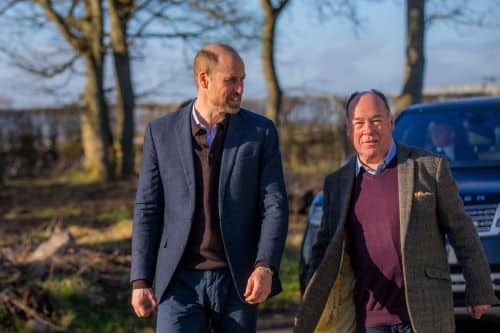
Vice Lord Lieutenant Malcolm Taylor welcomes Prince William to Angus for Rural Mental Health Talks

Bell Ingram’s Senior Partner, Malcolm Taylor, had the honour of welcoming His Royal Highness Prince William to Angus this week, in a visit that reinforced the Prince’s deep commitment to supporting mental health within rural communities.

The visit was part of a wider initiative aimed at addressing mental health challenges in the farming sector. Over the course of the day, the Prince visited several key locations, including the Men’s Shed in Carnoustie, where he met members and learned about the invaluable role the organisation plays in combating loneliness and isolation among older men. He also saw first-hand the devastation caused by Storm Ewoyn at a nearby strawberry farm and engaged in meaningful discussions with young farmers about the support available to them. Topics ranged from mental well-being to the positive role social media can play in strengthening community ties.

Malcolm, who was appointed Vice Lord-Lieutenant of Angus shortly before the Coronation of Their Majesties King Charles III and Queen Camilla in May 2023, has served the county for over a decade as a Deputy Lord-Lieutenant. His appointment is a reflection of his dedication to the local community and his deep understanding of both the challenges and opportunities facing rural Angus.

During the visit, the Duke of Rothesay – as Prince William is known in Scotland – demonstrated a genuine and informed interest in the issues being discussed. Malcolm observed that the Prince was “extremely engaged, asking searching and intelligent questions”, keen to gain a thorough understanding of the efforts being undertaken by local organisations to support those working and living in rural areas.

Mental health awareness in rural communities is a cause that Bell Ingram is proud to champion. As a corporate supporter of RSABI, the charity dedicated to helping farmers and those in the agricultural sector facing hardship, the company is committed to breaking down barriers around mental health discussions. The importance of this cause was further highlighted in 2023 when the Duchy of Cornwall, under Prince William’s leadership, launched a dedicated mental health strategy for Duchy tenants, prioritising well-being and encouraging open conversations about mental health.

At a roundtable event hosted by the Farm Safety Foundation, the Prince spoke about the need to remove “taboos and stigmas around mental health” – a message that resonated deeply with Malcolm and others in attendance. The visit reaffirmed the collective effort being made by local authorities, charities, and businesses to ensure those in rural communities receive the support they need.

Reflecting on the day, Malcolm underscored the significance of the Prince’s involvement, stating that his presence and thoughtful approach have further strengthened ongoing initiatives to improve mental health support in Angus.

Bell Ingram remains steadfast in its commitment to the well-being of rural communities. Under Malcolm Taylor’s leadership, both in his role as Vice Lord-Lieutenant and within the company as Senior Partner, Bell Ingram will continue to support initiatives that foster resilience, awareness, and lasting change for those living and working in Scotland’s countryside.
[staff_member id=’3372′]

Two Stirlingshire properties offer rare opportunity to own piece of Scottish architectural legacy

Two Stirlingshire properties with an illustrious past, each telling a unique story of the region’s rich history and charm have been brought to the residential market.

Callander Lodge and Callander Gardener’s House & Coach House, situated in the historic Leny Feus area of Callander offer a rare opportunity to own a piece of Scottish heritage.

Callander Lodge and Callander Lodge Gardener’s House & Coach House have been brought to the market by Scottish Estate Agents, Bell Ingram for offers over £350,000 and £250,000 respectively.

A striking example of Victorian architecture, Callander Lodge dates back to 1863 and has a distinguished history. Built for Colonel Robertson, a prominent figure in mid-19th century Callander, this villa was constructed during a period of significant local development following the arrival of the railway. As one of the finest villas in Leny Feus, the property catered to the growing influx of affluent tourists who flocked to the area during the summer months.

The Lodge’s timeless design includes period features such as ornate cornicing, decorative dado rails, and grand fireplaces. The addition of a late-19th-century conservatory and an Edwardian Baroque-style entrance porch enhances its architectural appeal. Its original purpose and grandeur remain evident, making it one of the most well-preserved homes in the area.

Set in 2.85 acres of mature, meticulously landscaped gardens, Callander Lodge reflects Colonel Robertson’s deep interest in horticulture. The gardens, featuring an array of mature trees and shrubs, offer a tranquil setting that beautifully complements the grandeur of the house.

Situated nearby, the detached Callander Gardener’s House & Coach House offer a unique renovation opportunity for buyers interested in restoring a piece of history. Also dating from the 19th century and linked to the area’s expansion due to the arrival of the railway, this property was originally built as a gatehouse. Its gardens once served as the kitchen garden for Callander Lodge.

Constructed of traditional stone with a slate roof, the Gardener’s House and the attached Coach House sit in grounds extending to 0.42 acres. While the Gardener’s House is in need of significant renovation, the adjoining stables and coach house provide ample scope for further development, subject to necessary planning approvals. With its period features, fireplaces, and ample space, this property offers tremendous potential for transformation into a unique residence.

Leny Feus, where both properties are located, holds a special place in Callander’s history. Developed in response to the expansion of the railway in the 19th century, the area became a popular destination for wealthy visitors. Homes such as Callander Lodge and Callander Gardener’s House were purpose-built to cater to this demand, adding to the region’s charm and prosperity.

Callander Lodge remains a symbol of the era’s architectural ambitions and aesthetic sensibilities. Meanwhile, Callander Gardener’s House and Coach House offer a more rustic, yet equally fascinating, glimpse into the region’s past, with the potential for a new chapter in their long history.

For anyone with a passion for history and heritage, these properties present a rare opportunity to own a significant piece of Callander’s architectural legacy.

Commenting on the sale, estate agent, Carl Warden, says: “These properties are not only remarkable for their architectural significance, but also for their deep connection to the rich heritage of the area. Whether you’re looking for a beautifully preserved Victorian villa or a restoration project with immense potential, these homes are steeped in character and history, offering an exceptional chance to create something truly special.”

For more information on these properties visit bellingram.co.uk or contact our Perth Estate Agency team on 01738 621 121 or email carl.warden@bellingram.co.uk.

[staff_member id=’3397′]

Time to get your ducks in a row for tax changes

By Sarah Tyson, Head of Valuations.

In these dark days of winter, many are wondering what to do to manage the proposed changes to inheritance tax reliefs following the October 2024 budget. The key message is to start taking stock of what you have and work with those who can help you – likely to be your team of land agent, lawyer and accountant who can confirm all the details which will be needed.

Even if the ongoing protests and opposition to the proposals achieve some changes, to carry out a business review and get up to date information is good business practice – much better than either knee jerk reactions or inertia.

Key elements to review including checking:

  • List and ownership of assets; land, houses, equipment and livestock.

  • Details of any partnership agreements.

  • Wills – for all involved, since deaths do not always occur in age order.

  • Any tenancy agreements – whether you are landlord or tenant and whether whole farm, one element or a telecom mast.

  • Diversification projects – just who is involved and on what basis? Including renewable energy.

  • Current values of all the above so that possible tax liabilities can be assessed.

Pulling together all these details, working with your advisors and asking questions if unclear, will give you a sound basis to make informed decisions.

There is no ‘one size fits all’, but careful consideration of all the facts for your situation will enable a plan to be made.

If you would assistance with a business review, contact our Head of Valuation, Sarah Tyson on 01738 621 121 or email sarah.tyson@bellingram.co.uk.

[staff_member id=’3390′]

Discover a Highland Haven at Keeper’s Cottage

Keeper’s Cottage, a charming former croft house nestled in the heart of the Northwest Highlands has been brought to market.

Situated in the picturesque hamlet of Elphin, this south-facing retreat enjoys an elevated position, offering breathtaking views over sweeping croft land and the dramatic mountain backdrop beyond. Just a stone’s throw away lies the renowned Knockan Crag National Nature Reserve, a jewel within the Northwest Highland Geopark and a haven for nature enthusiasts.

Rural estate agents, Bell Ingram is marketing the property for offers over £240,000.

Keeper’s Cottage combines traditional charm with modern comforts. Thoughtfully extended from its original crofting design, the property now boasts a spacious living room with an exposed stone fireplace and wood-burning stove, a welcoming dining kitchen featuring an oil-fired Aga, a utility room, and a family bathroom on the ground floor. Upstairs, three bedrooms, including a cosy single, provide ample accommodation. A floored attic, accessible via ladder, has been transformed into a tranquil home office, complete with a gable window framing spectacular mountain views.

Surrounded by a beautifully maintained garden, the property features two traditional stone outbuildings, a wooden shed for extra storage, and a walled vegetable garden – a delightful space for cultivating produce while soaking in the highland surroundings.

For equestrian enthusiasts or those seeking additional space, an adjacent plot with a stone outbuilding, ideal for conversion into a stable, is available by separate negotiation.

Estate Agent Joanne Stennett of Bell Ingram remarks, “Keeper’s Cottage embodies everything that makes the Northwest Highlands so magical. Its traditional charm, combined with modern comforts, offers the perfect escape, whether you’re seeking a full-time home or a holiday haven. The surrounding landscape is simply unparalleled in its beauty, making this property an extraordinary find.”

If you’ve been dreaming of your own highland retreat, look no further than Keeper’s Cottage. For further details or to arrange a viewing, contact Joanne Stennett at Bell Ingram on 01463 717799.

125 Years of Bell Ingram: A Legacy of Adaptation and Innovation

As Bell Ingram celebrates its 125th anniversary on 13 November 2024, it’s an opportunity to reflect on a long and evolving history in the field of land management. The firm, established in 1899, has witnessed – and adapted to – significant changes in the world of estate management. From its origins in Victorian Scotland to its contemporary role, our journey reflects the broader transformation of land ownership and management over more than a century.

A Glimpse into 1899

In 1899, Scotland was still very much in the final years of the Victorian era. The world of land management was quite different from what it is today, in Scotland particularly. Large estates dominated the landscape, and the advent of trains and steamships had opened up the Highlands, attracting visitors for sporting and hunting opportunities. During this period, large-scale private land ownership was dominant, with landed estates in their prime.

An 1872-73 government survey revealed that in the UK, a mere 7,000 people owned 80% of the land. The situation in Scotland was even more concentrated, with 659 landowners controlling 80% of the land area, and just 15 individuals owning over half of the Highlands. The estates of this era were expansive and landowners and their managing agents or “factors” wielded significant influence.

The Changing Landscape of Estate Ownership

Over the past 125 years, the dominance of large estates has gradually diminished. The breakup of vast estates like Sutherland and Lord Leverhulme’s holdings in Lewis and Harris marked a shift toward smaller, more fragmented ownership. In the early 20th century, the average size of estates began to shrink, and by 2024, few estates remain larger than 5,000 acres. The number of estates sold on the open market has reduced and there is now no such thing as a typical estate purchaser.

Despite these changes, private ownership of rural Scotland remains significant. Currently, private entities own 83% of rural land. Interestingly, 50% of privately-owned rural land is held by just 433 landowners, a slight decrease from 2012. Community ownership has however increased, with around 212,342 hectares now held by local communities – a 23% rise from 2012*.

Factors Behind the Decline of Large Estates

In the 20th century, heavy taxation, such as estate duties and inheritance taxes, played a major role in breaking up many estates. Government bodies like the Forestry Commission and the Department of Agriculture also purchased large tracts of land. Additionally, political aims and reforms to Scotland’s feudal system have had a lasting impact on land ownership and management.

In England too, the public bodies expanded and economies of scale forced owner occupied farmers to expand reducing the number of small, family farms.

One of the most debated trends in post-World War II Scotland has been the purchase of large estates by overseas buyers. While these foreign owners have sometimes been met with public criticism, most have proven to be responsible stewards of the landscape and the local communities they impact. Across the UK charities such as the National Trust and RSPB have also expanded ownership especially in some of the most beautiful areas of the countryside and National Parks.

The Role of Good Estate Management

No matter who owns the land, one thing has remained constant: the importance of good estate management. Whether managing farms, woodlands, sporting estates, or residential properties, responsible management is essential for a thriving rural economy. Effective estate management today involves not only a deep understanding of the land but also expertise in business, modern technologies and commercial ventures.

This is where firms like Bell Ingram come into play. Since its founding in 1899, Bell Ingram has provided a range of professional land agency services. The company has grown substantially over the past century, evolving alongside the changing needs of the land and its owners. Our agents and their colleagues have to be able to flex and continually update themselves and their clients, to keep up with an ever changing game.

Looking to the Future

As Bell Ingram marks its 125th anniversary, the firm’s evolution reflects the broader changes in rural estates and other aspects of property management. In the late 19th century, estates were fully staffed with foresters, building clerks of works, farm managers and gamekeepers. However, as estate sizes decreased and incomes contracted, so too did the need for such extensive staffing. Bell Ingram has adapted to these changes, providing specialised services to landowners whether public or private who no longer maintain the large in-house teams of the past.

But what about the next 125 years? The future of land management across the UK is uncertain. Factors such as climate change, improving technology, web-based sales, agricultural support (or lack of it) and the shifting political landscape will undoubtedly play a role in shaping the future. A new Labour government in Westminster, along with the continued evolution of the Scottish Parliament’s approach to land reform, suggests that significant changes are on the horizon.

The Modern Land Agent

The role of the land agent has evolved hugely over the past century, and it will likely continue to do so. Today’s rural professionals must possess not only traditional estate management skills but also expertise in areas like environmental regulation, agricultural policy and renewable energy. As the rural environment becomes increasingly complex, specialisation within estate management has become more common, supported by technology from GIS Mapping to accountancy packages and by a wider range of in-house colleagues.

Our teams are changing – 125 years ago all the agents and professionals were men, albeit supported by doughty ladies as estate secretaries, often similarly dressed in tweeds and brogues! Today many of our professional staff are female, from partner to trainee level, reflecting changes in society over the last century and involved in all areas from architecture to mapping and property sales.

A New Era of Change

Over the past century, land management has moved on from handsaws to timber processors, from horses to satellite-linked combines, and from handwritten letters to emails. As the world continues to change at an ever increasing pace, all our staff must stay ahead of the curve and be equipped to meet the challenges of the future.

The next 125 years may hold even more dramatic shifts, but one thing is certain: Bell Ingram will continue to adapt, innovate, and provide expert services to landowners as it has done for over a century. The company’s commitment to excellence in all aspects of our clients’ interests in the countryside ensures that it remains a trusted partner in the rural landscape for generations to come.

*Reference: Who Owns Scotland website.

Bell Ingram Celebrates Landmark Anniversary Serving Rural Communities in Scotland

Bell Ingram, a rural and property services firm founded in Perth, is celebrating its 125th anniversary this year by planting commemorative trees at its headquarters on Isla Road, overlooking the River Tay.

This milestone event reflects the firm’s enduring roots in Perthshire and its commitment to serving its local communities across Scotland. Bailie Chris Ahern from Perth & Kinross Council joined the Bell Ingram team for the commemorative planting ceremony, underscoring the company’s strong connection to the Fair City.

Since its founding on 13th November 1899, when Henry J. Bell opened his practice on Charlotte Street, Bell Ingram has grown from a small land management consultancy into a leader in rural and property services with over 100 specialists across Scotland and the North of England, with offices in Perth, Forfar, Aberdeen, Beauly, Oban, Ayr, Northwich, Kendal, Thirsk and Morpeth.

Today, Bell Ingram’s dedicated team provides expertise in rural land management, farm consultancy, AMC agency, estate agency, forestry, accountancy, utilities, renewables and mapping.

The company will come together on Thursday, 14th November for its 125 Anniversary Conference and Gala Dinner at Crieff Hydro where staff, and partners will gather to reflect on the firm’s legacy and discuss the future of land and property services.

Mark Mitchell, Managing Partner at Bell Ingram, reflected on the company’s anniversary, saying: “As we celebrate 125 years, we acknowledge that our people are at the core of our success. Their dedication and expertise have earned the trust of clients throughout the UK, bringing a wealth of local knowledge and commitment to every project.

“Today, we offer a full suite of land agency services, and our professionals are out there every day, shaping the rural landscape. Whether advising on pipelines or renewables, surveying property, designing buildings or managing estates, our teams understand the lay of the land like no one else.”

Mark Mitchell also noted the company’s commitment to addressing new challenges, including environmental issues and evolving land reforms.

He added: “Bell Ingram is ready to lead the way in developing sustainable, innovative solutions. Our legacy of adaptability and resilience provides a solid foundation for us to continue meeting the needs of today’s world.”

As Bell Ingram commemorates its 125th year, the business looks forward to continuing its work across rural Scotland, with a deep-rooted commitment to serving local communities and the land itself.

Bringing the Spirit of the Canadian Rockies to the Scottish Highlands – Rare Pioneer Log Home for Sale

An extraordinary four-bedroom, handcrafted Canadian log home nestled in the scenic Highlands has come to market.

Located in Daviot and only a short commute from Inverness, this remarkable property, available for offers over £950,000, brings an authentic piece of the Canadian Rockies to Scotland – a rare find for those seeking a unique blend of natural beauty and unparalleled craftsmanship.

Blackcroft Lodge was meticulously constructed by the renowned Pioneer Log Homes of British Columbia, using sustainably sourced Western Red Cedar and a traditional hand-scribing technique. Hand-scribing, a hallmark of high-quality log home construction, involves expertly fitting each log by hand to create a seamless, snug structure. This level of artistry is seldom found in the UK and makes Blackcroft Lodge a true gem in the Highlands.

Set across three floors, the home showcases breathtaking woodwork and spacious interiors, each room radiating the warmth and character of the handcrafted logs. Floor-to-ceiling windows bathe the spaces in natural light, while the intricate joinery of the pillars and beams highlights the artistry that went into each log’s unique texture and pattern. Complemented by tasteful décor, the craftsmanship is evident in every corner, creating a welcoming, yet awe-inspiring atmosphere.

Blackcroft Lodge provides expansive living areas perfect for a family home or a potential bed and breakfast. Additional space in the basement allows for further development – ideal for a home gym, cinema, or additional guest accommodations. Modern conveniences such as high-quality copper-clad double glazing and underfloor heating on two floors enhance comfort, with a central wood-burning stove providing eco-friendly warmth and the option for an additional oil or gas heating system if desired.

The home’s layout offers an inviting blend of indoor and outdoor spaces, with French doors leading to a wraparound balcony overlooking open countryside. The kitchen, with its high-gloss cream units and solid oak work surfaces, seamlessly blends practicality with elegance, while the dining area provides sweeping views of the Scottish landscape.

Perched on over an acre of elevated land, Blackcroft Lodge is surrounded by fenced, secure gardens and offers ample parking. This tranquil setting, combined with the lodge’s intricate design and rare craftsmanship, brings the essence of Canada’s wilderness to the heart of Scotland’s Highlands.

Rural property experts, Bell Ingram are managing the sale. Estate Agent Joanne Stennett comments, “This is a truly unique property. The craftsmanship is breathtaking, especially in the carefully crafted pillars and beams that showcase the natural beauty of each individual log. Blackcroft Lodge is not just a home; it’s a work of art that complements its serene rural landscape.”

For more information or to arrange a viewing, please contact Joanne Stennett at Bell Ingram on 01463 717799.

‘Serene Hideaway Island’ for sale in one of Scotland’s most stunning Sea Lochs

A private island with exceptional natural beauty and ecological richness has come to the market in the West Highlands, one of Scotland’s most picturesque regions.

The sale of Eilean Mor, a breathtaking 29.98-acre (12.14-hectare) island in Loch Sunart offers nature enthusiasts a rare opportunity to own their own serene hideaway island.

Accessible only by boat or a scenic low-tide causeway, Eilean Mor provides an immersive experience into Scotland’s unspoiled wilderness. With diverse terrain and stunning views of the Inner Hebrides, the island’s pristine environment is a sanctuary for native wildlife, including vibrant seabird populations and diverse marine life, offering visitors a glimpse into the thriving ecosystems of the Inner Hebrides.

Located in Loch Stunart, a sea loch off the Ardnamurchan peninsular, Eilean Mor presents a haven for birdwatchers and nature enthusiasts with herons and seals regular visitors to the loch shores. Rarer species such as golden and white tailed eagles are also known to frequent the shores.

The shores of Loch Sunart are also home to some of the finest temperate oakwoods in the British Isles. These are remnants of an extensive band of coastal woodland that once stretched down the Atlantic coast of Europe from Norway and Scotland as far as Spain and Portugal. The woodland at Sunart’s shores are home to some of Europe’s best collections of lichens, mosses and liverworts.

While currently uninhabited, Eilean Mor has a storied past that intertwines with the local heritage of the surrounding Highlands. The island, held by the same family for generations, now awaits new stewardship and invites fresh opportunity and exploration.

This property does not currently hold planning permissions, offering a blank canvas for prospective buyers who dream of a secluded retreat that captures Scotland’s authentic natural beauty and heritage.

Eilean Mor is brought to the market with rural property experts, Bell Ingram for offers over £325,000. Commenting on the sale, Estate Agent, Andrew Fuller says: “For interested parties, Eilean Mor represents more than just an investment; it is a unique chance to own a piece of Scotland’s wild beauty, a serene hideaway, and a historic landmark to be cherished and preserved for generations to come.”

Aigas Golf Course and Holiday Cottages: A Unique Business Opportunity Combining Scenic Leisure and Potential Expansion

A rare and exciting opportunity has emerged for potential buyers seeking to acquire a beautifully maintained golf course with extensive holiday letting potential, nestled in the scenic Highlands of Scotland.

Brought to market by Highland Estate Agents, Bell Ingram for offers over £1,500,000, Aigas Golf Course, established in 1993, presents a unique combination of recreational, hospitality, and agricultural opportunities.

Situated amidst 30 acres of rolling parkland this well-established facility offers a turnkey operation for new proprietors with substantial potential for future growth.

The nine-hole Aigas Golf Course is a meticulously landscaped, family-friendly course that has garnered loyal members over the years. Along with the manicured greens, the property includes a practice area and a clubhouse that features a well-equipped kitchen, office, rear lobby, and WCs (including a disabled-accessible WC). The clubhouse is a welcoming hub for golfers, offering light refreshments and snacks, making it an ideal spot for both members and visitors to relax post-round.

The course is home to the Aigas Golf Club, an independently run organisation that utilises the course as its base during the golfing season. To ensure a smooth transition, the current owner is prepared to offer training and support to the new proprietor, providing an excellent opportunity for continued success.

“We are delighted to bring Aigas Golf Course to the Highlands commercial property market,” says Estate Agent, Joanne Stennett. “This is a truly unique opportunity for buyers looking to invest in a versatile and thriving business. With its stunning natural surroundings and well-maintained facilities, this property offers immense potential for both leisure and hospitality ventures. A rare gem in the Highlands market.” 

In addition to the golf course, Aigas boasts four self-catering cottages, offering a well-established stream of rental income from the tourism sector. Currently operating from March to November, there is ample opportunity to extend the rental period year-round and tap into the growing demand for winter breaks in the Highlands. All cottages are fully furnished and come with access to a laundry room and games room.

The Coach House is a spacious three-bedroom, two-storey cottage located on the West wing of a Victorian courtyard. Overlooking a serene mill pond, it features a cozy living area with a log burning stove, making it a favourite among visitors.

Pond View is a charming three-bedroom, first-floor cottage, accessed by a beautiful stone staircase. Offering stunning views over the golf course and surrounding countryside, it provides an idyllic retreat for guests.

Old Dairy and Old Stable are two delightful ground-floor cottages on the East wing. Both are two-bedroom properties, with scenic views over the course and neighbouring forests. The cottages share access to a peaceful communal garden, BBQ area, and outdoor seating, ideal for relaxing on warm summer days.

Adjacent to the holiday accommodation are several steadings and farm buildings. These buildings vary in construction and condition, but the traditional stone structures, in particular, may present excellent redevelopment potential with the necessary consents. Whether for expansion of the holiday accommodation or agricultural purposes, the buildings offer flexibility for the new owner’s vision.

Aigas Golf Course is also complemented by approximately 26 acres of agricultural land, which offers opportunities for continued grass production or diversified agricultural activities. The land is well-fenced and benefits from river frontage, making it suitable for high-quality agricultural production.