Embracing Opportunities in the Scottish Highlands
As we transition into the vibrant months of May and June, Bell Ingram is delighted to report a surge in property listings following a damp start to the year. The Scottish Highlands, with its breathtaking landscapes and tranquil environment, continues to attract a diverse range of buyers, and our estate agency is at the forefront of this dynamic market.
High Demand for Semi-Rural Properties
One notable trend we’ve observed is the increasing popularity of semi-rural properties. These homes, offering a perfect blend of solitude and accessibility, have captured the hearts of many buyers. Properties that are set alone yet provide easy access to local amenities are particularly favoured. At Bell Ingram, we have been witnessing high demand in this segment, with numerous properties selling at a significant uplift. This trend underscores the unique appeal of the Highlands, where residents can enjoy the peace of rural living without sacrificing convenience.
Middle Market Momentum
The middle market has also shown remarkable resilience and growth. Buyers in this market have found it easier to secure mortgages, fostering greater confidence and activity. This accessibility to financing options has invigorated the market, allowing more individuals and families to pursue their dream homes in the Highlands.
Looking Ahead: Market Expectations
While the market is currently robust, we understand that some buyers remain cautious, waiting to see if the Bank of England will lower interest rates. Should this happen, we anticipate an even more buoyant market. However, we are mindful that this potential uptick could coincide with the quieter summer months, when many people are enjoying their holidays. Regardless of these seasonal fluctuations, Bell Ingram is prepared to navigate these changes, ensuring our clients receive the best possible service and opportunities.
Why Choose Bell Ingram?
Bell Ingram’s deep-rooted expertise and local knowledge make us the ideal partner for those looking to buy or sell property in the Scottish Highlands. Our team is dedicated to providing personalised service, leveraging our extensive network and market insights to deliver exceptional results. Whether you’re seeking a secluded rural retreat or a conveniently located home, we have the resources and commitment to help you find your perfect property.
For more information on our listings and services, please visit click here, or contact our team directly on 01463 717799. We look forward to helping you find your dream home in the Scottish Highlands.
Additional Dwelling Supplement and what it means for second home owners in Scotland
Our Oban Estate Agent Andrew Fuller discusses Additional Dwelling Supplement in Scotland.
The Additional Dwelling Supplement (ADS) is a tax measure in Scotland aimed at curbing the acquisition of second homes and investment properties with the hope of promoting home ownership among residents. The tax applies to the purchase of additional residential properties, including holiday homes and buy-to-let properties and is applicable if the total purchase price of the property exceeds £40,000.
Anyone purchasing a second or subsequent residential property in Scotland may be liable for ADS. This includes individuals, companies, and other entities. It’s important to note that ADS is payable in addition to the standard Land and Buildings Transaction Tax (LBTT). For example, if you already own a home and decide to buy another, you will be required to pay ADS on the new property, regardless of whether it’s an investment or a holiday retreat.
The ADS rate is currently set at 6% of the total purchase price of the property. This rate is applied uniformly, meaning there’s no tiered system as with LBTT. For instance, on a property purchased for £250,000, the ADS would amount to £15,000. As demonstrated, ADS can result in a significant addition to the overall purchase price. As professional estate agents, it is our duty to make purchasers aware of the ADS in order that this tax can be factored in pre-offer.
Bell Ingram Oban recently listed a single portfolio of three island properties, comprising three-bedroom family residence and two self-contained one-bedroom holiday letting cottages, all set within around 19 acres of coastal frontage. Whist the main three-bedroom residence is highly likely to become a family home, the two letting cottages are each subject to the ADS. In this instance, the valuation of the main house is covered by the mortgage valuation within the Home Report, therefore an independent valuation is required to determine the taxable value for each cottage.
The implementation of ADS reflects the Scottish Government’s commitment to improve housing affordability and availability for primary residences by discouraging the acquisition of multiple properties by investors and/or wealthier individuals. The aim is to level the playing field by giving first-time buyers a better chance in a competitive property market. Prospective buyers of second homes or investment properties must carefully consider this additional cost when planning their purchases.
If you are looking for property advice in the Argyll & Bute region, contact our Oban team on 01631 566 122 or email Andrew.fuller@bellingram.co.uk.
Bell Ingram moves to new office in Kendal serving Cumbria and North Lancashire
Bell Ingram is delighted to announce the official opening of our new office at Martindale House, Murley Moss Business Park, Oxenholme Road, Kendal, Cumbria.
This strategic move marks an important milestone in Bell Ingram’s commitment to providing exceptional service and expertise to clients across Cumbria and North Lancashire.
The Kendal office will be staffed by a dedicated team of professionals who bring a wealth of experience and local knowledge to the region.
Andrew Thompson, Senior Associate, is a RICS Chartered Surveyor and Registered Valuer. He has extensive experience working on a variety of utility and land management projects throughout Cumbria and North Lancashire. Andrew’s expertise and dedication ensure that clients receive the highest level of service and support.
Joe Greene, Associate, is a RICS Chartered Surveyor and Registered Valuer specialising in Utilities and Rural Land Management. Since joining Bell Ingram in 2019, Joe has achieved an MSc in Real Estate, passed his RICS professional examinations and developed a strong client base within the utilities and renewables sectors.
Cameron Dargue, Graduate Land Agent, is a recent addition to the Bell Ingram team. From a farming background, Cameron works across Cumbria, with a focus on supporting clients in the utilities and renewables sectors. He joined Bell Ingram in Summer 2023 and holds a BA (Hons) in Geography from Manchester Metropolitan University.
Andrew Thompson said: “I’m looking forward to working from this purpose-built office space in Kendal as the location is shared with a number of complimentary service providers and has many opportunities to network. It’s the perfect location for us to continue providing excellent service to our clients across the region. The new office will allow us to work more efficiently and collaboratively, which is a huge plus for our team and our clients.”
Neal Salomon, Head of Utilities at Bell Ingram, continued: “We are delighted to expand our presence in Kendal and enhance our services in this vibrant region. With the opening of our new office, we aim to provide unparalleled expertise and support to our clients, helping them navigate the complexities of land management with confidence.”
The new Kendal office reinforces Bell Ingram’s dedication to serving the rural communities of Cumbria and North Lancashire. The firm’s comprehensive range of services includes estate management, valuation, utilities and renewables consultancy, tailored to meet the unique needs of each client.
For more information about Bell Ingram and the services offered at the Kendal office, please contact the team on 01539 896 101.
Scottish Government opens consultation on Crofting Reform
Crofting has a high historical and cultural importance to the Highland and Islands communities. Unique to Scotland, the land tenure promotes sustainable land use by local individuals where the land has often been crofted by their families for generations.
According to the Crofting Commission there are approximately 21,500 Crofts recorded. To be a Crofter, the owner or the tenant of the Croft, must ordinarily be resident on, or within 32km of, their croft, they have a duty to cultivate and maintain their croft or put it to another purposeful use and they have a duty not to misuse of neglect their croft.
The main pieces of legislation relating to crofting are the Crofters (Scotland) Act 1993, as amended by the Crofting Reform (Scotland) Act 2003, the Crofting Reform (Scotland) Act 2010 and the Crofting (Amendment) (Scotland) Act 2013. Now, the Scottish Government has opened up a consultation on proposals for changes and simplifications to crofting law. They are seeking views on proposals on:
Entry to crofting
Crofting communities
Use of Common Grazings
Strengthening residency and land use
Enhance Crofting Commission powers
Simplifying crofting
The government wish to build on previous reforms to help more people to become crofters and improve support for existing crofters, enable more and different activities to take place on common grazings such as projects that are in line with environmental initiatives, streamline the process for breaches of crofters duties and to resolve crofting regulatory issues more quickly.
At present, only one crofter can be registered to a croft and any assignation of a crofting tenancy can only be to one person. One of the proposals considers being able to create a joint crofting tenancy which would allow two people to be registered to a single croft. This is to be inline with other forms of tenancies available in the country such as the residential PRT agreements.
Senior Surveyor at Bell Ingram, Hamish Hope comments: “The thought behind this is to allow crofters to use more resources from each party and in situations where an older crofter wishes to pass their tenancy to another family member but still wishes to remain as a tenant. The risk here is that a crofting tenancy is a heritable tenancy and if there were joint tenants, there could be a conflict on the future of the croft which would add complications to an already complicated land tenure. The consultation paper discusses this further.”
Another proposal is in relation to Common Grazings, which are areas of land where multiple crofters have a right to graze the land known as a share. Common Grazings account for approximately 550,000 hectares of land in the country.
Hamish continues: “Common Grazings are being used less and less with livestock numbers on crofts declining. The government proposes to remove barriers that will allow crofters to use common grazing land for other purposes such as woodland creation, biodiversity enhancement and peatland restoration. This could bring more income to the related crofting community and built stronger relationships. To do this, the roles of Grazing Committees need to be more simple and clear and Crofters need to be encouraged to actively use their shares.”
To read the full Crofting Consultation Report which covers all aspects of the proposals, please click here. For all information regarding Crofting, please visit the Crofting Commission here.
If you wish to discuss crofting with one of our land agents, please contact Bell Ingram here.
Bell Ingram brings two productive farming units to market just north of Perth
Bell Ingram is delighted to announce the release of two highly productive farming units for sale, strategically positioned just north of Perth with easy access to the A9.
Extending to approximately 91.38 hectares (225 acres), these properties are available as a whole for offers over £2,575,000 or can be purchased in three separate lots.
The farms feature a combination of predominantly Grade 3(1) land, with certain areas classified as Grade 2. The land benefits from modern agricultural infrastructure, including steel agricultural sheds constructed in 2008, 2010, and 2014, and a traditional four-bedroom farmhouse.
Property Highlights:
- Lot 1: North Barns Farm – This lot includes the main farming unit, featuring three sizable steel agricultural sheds and a mix of Grade 2 and 3(1) land.
- Lot 2: Coltrannie Farm – Also featuring predominantly Grade 3(1) land with easy access provided by the newly constructed Coltrannie road bridge over the A9.
- Lot 3: North Barns Farmhouse – A traditional stone-built property with two public rooms, four bedrooms (three en suite), garden ground, and an adjacent paddock extending to about 1.08 hectares (2.67 acres).
The local area is well-served by a variety of agricultural contractors, merchants, and suppliers, with additional farming resources available through a successful local machinery ring. Regular livestock sales are conducted at the Stirling Agricultural Centre, enhancing the convenience for potential buyers.
Commenting on the property, Estate Agent Carl Warden said: “These two productive farming units, with the benefit of agricultural buildings and a traditional farmhouse, represent a rare and valuable opportunity for agricultural investors and farmers alike. Their prime location, combined with high-quality land and modern facilities, make them an exceptional offering in today’s market.”
For more information or to arrange a viewing, please contact Carl Warden at 01738 621 121 or via email at carl.warden@bellingram.co.uk.
Caring for Carers: How Bell Ingram’s Support Helps Me Balance Work and Family Responsibilities
My dad always called my Mum his “treasure” and in the last year of his life he rolled his wheelchair through to her room every evening before bedtime to tell her that he loved her.
Dad died before Christmas last year. He was 93 years old and had been having treatment for late stage prostate cancer. Ironically it wasn’t the cancer that took him in the end, but a chest infection that developed into pneumonia.
With the help of the ‘hospital at home’ team, my sister and I nursed him at home and he died, just as we wanted, in his own bed surrounded by family. We miss him very much.
Dad’s death was the end of a journey which began in 2022 when my sister decided to give up her job to become a full time caregiver for our parents. At this point in time our mum had just been discharged from a six week stay in hospital after developing sepsis from UTI, and dad was increasingly reliant on his wheelchair.
We did discuss moving mum and dad into a care home, but my sister decided to take a career break instead which allowed them to remain in their home. Since then, she’s taken on the bulk of the caring responsibilities, with support from both me and our cousin who lives nearby.
Mum is now 87 year old and has despite the efforts of physios, completely bedridden and still suffering from post-sepsis syndrome.
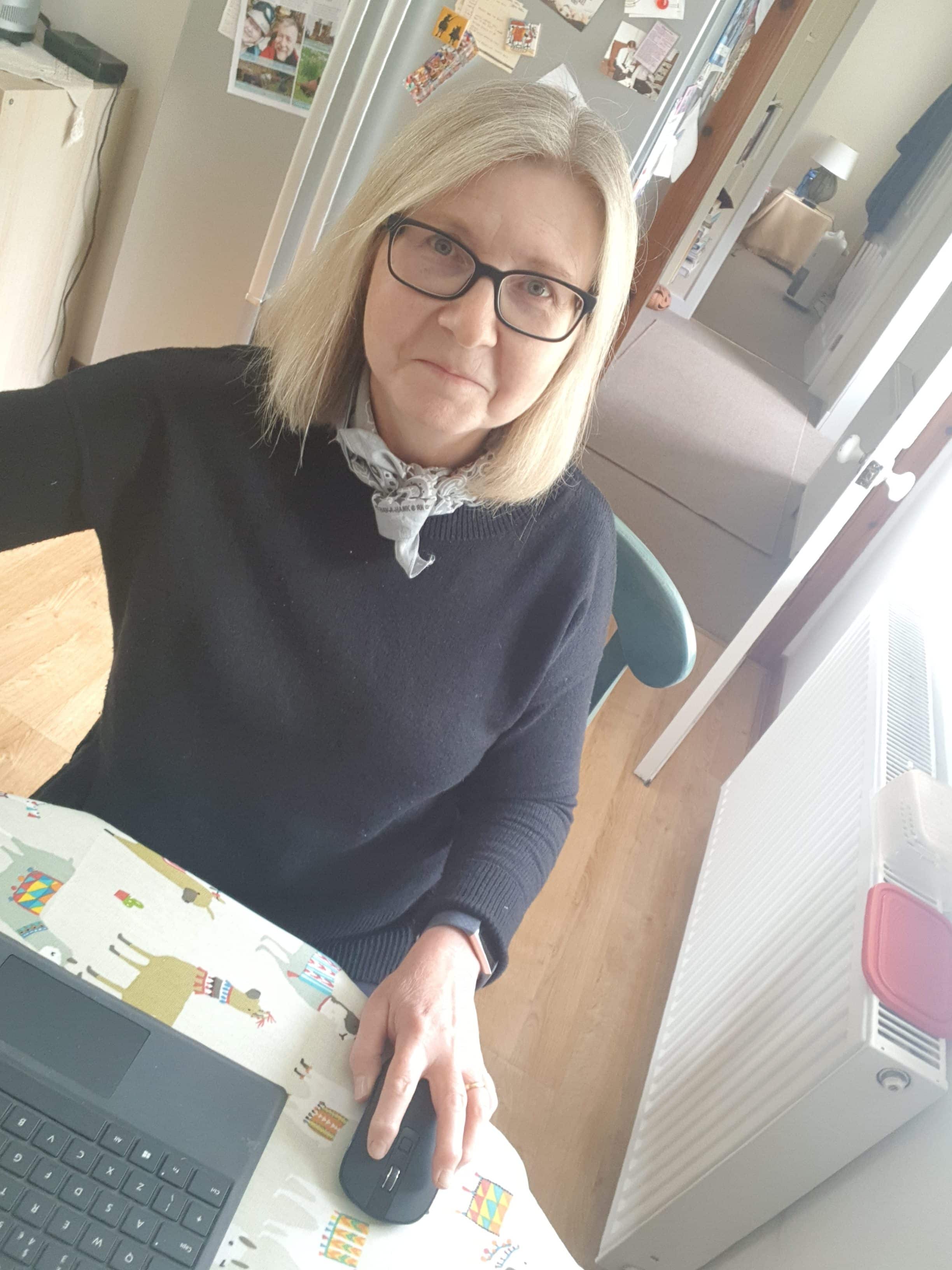
Fortunately Bell Ingram’s flexible working policy allows me to work remotely from mum’s flat most weeks for a couple of days which gives my sister some much needed respite. Outwith the agricultural show season, which involves a lot of events management, my job as marketing manager is well suited to hybrid working. As long as I have Internet I can work from just about anywhere.
As well as the support I get from both my line manager Mark and HR manager Kirsty, I’m also a member of Bell Ingram’s Carers Group who meet every couple of months on Teams to swap information and support each other.
Here’s what an average day looks like when I’m working remotely from my mum’s:
3.30am: I set the alarm for the early hours so I can check on mum. She doesn’t sleep very well so I like to make sure that her TV hasn’t turned itself off (she loves a bit of Downton Abbey!). I freshen up her hot water bottles and reposition her pillows to make her as comfortable as possible. Mum’s often hungry so it’s not unusual to be making sandwiches or a bowl of porridge. We often look at old photos and it’s lovely to remember all the good times.
6am: Check on mum and unlock the front door to let in her caregivers. Mum has a council care package and gets four visits a day to help with her personal care. We have a regular team of ladies on the rota, and they work in pairs.
6.30am: We’re lucky to have a small pool and gym in mum’s block of flats, so I pop downstairs for a quick swim. Exercise is important for my mental health and I enjoy this quiet time to go through my ‘to do’ list for rest of the day.
7.30am: Back upstairs to make breakfast. Usually porridge for mum, and cereal for me. She’s not a big eater these days so it’s a big win if she manages to finish her small bowl.
8am: I settle down at my home office/kitchen table to start my working day. My colleague Eleanor is an early bird as well so we kick the day off with a Teams call to go through our task list.
11am: Visit from the district nurse to take bloods. Mum currently has a vitamin deficiency (magnesium and potassium) and we need to check if the supplements are working. This is always a bit traumatic since mum finds it painful, but this time the nurse got a sample at her first attempt.
Midday: Headed out to Greggs for a frothy coffee and caramel fudge donut. Mum doesn’t have much of an appetite but can usually be persuaded by a sweet treat!
3pm: Teams meeting with the Bell Ingram Carers Group. To tie in with Carers Week we’ve invited a guest speaker from the local carers’ group in Perth.
5pm-10pm: I usually spend the evenings catching up with paperwork. My sister and I have power of attorney for mum so it’s my job to make sure all the bills are paid. Once that’s done, I tidy up, put the washing on and sort out mum’s medication for the next day. If I ask her what she wants for dinner she always says she’s not hungry, but if I make something and put it in front of her she usually manages a few bites. Tonight it was fish and chips and a bowl of strawberries.
10pm: We start mum’s bedtime routine. Arms, legs and neck are massaged with ibuprofen gel to stop cramps, pillows adjusted, medication given, lights dimmed and TV turned onto Downton Abbey. Remote control and her little bell are left within easy reach so she can ring if she needs me during the night.

High Demand and Premium Prices Define the Current Farm Sales Market
Demand for land remains high across the rural property spectrum, from standalone, working farms right through to small parcels and pony paddocks.
In coastal Angus, prime arable land can reach up to £20,000 per acre, reflecting the area’s high yielding soils for crops, fruit and vegetables. Secondary arable and temporary grassland prices have seen slight increases over the last two years, while poorer quality parcels remain stable.
Our Farm Sales specialists in Scotland are experiencing high demand for our services this season for a variety of reasons including unpredictability in the industry and many farmers looking to their primary asset for retirement funding.
Browse some of our farm properties on the market here:
North Barns & Coltrannie Farms, Bankfoot, Perthshire
Two productive farming units in an easily accessible position just north of Perth, convenient for the A9. Predominantly Grade 3(1) with areas of Grade 2, with modern agricultural sheds and a traditionally constructed four-bedroom farmhouse. As a whole or in 3 lots.
Offers over £2,575,000.
North Mains of Invereighty, Forfar, Angus
North Mains of Invereighty is excellent, well equipped arable unit with first class principal house in a renowned farming area of Angus. The land extends to approximately 54.25 hectares (134 acres).
Offers over £2,000,000.
Highly productive arable farm located in central Angus. Extending to about 39.30 hectares (97.11 acres) and includes a traditional three bedroom farmhouse and range of farms buildings. The land is classified principally class 3:1.
Offers over £1,300,000.
South Bank Farm, Isle of Arran
Excellent opportunity to acquire a most attractive farm with traditional farmhouse on the Isle of Arran. Uninterrupted sea views towards Ailsa Craig and the Ayrshire Coast. Approximately 121.55 hectares (300.36 acres). For sale as a whole or in three lots.
Offers over £1,100,000.
Lands at West Mains of Whitewell, Oathlaw, Angus
An attractive block of well-located arable land extending to approximately 43.89 hectares (108.45 acres). A well-proportioned and accessible range of arable fields as well as amenity woodland and river frontage. The land has been run on an arable rotation which includes potatoes, peas, cereals and grass.
Offers over £810,000.
Arable and grazing land with an agricultural building with potential for “one for one” development site, subject to planning approval. About 48.54 hectares (119.94 acres) of predominantly Grade 4(1) and 4(2).
Offers over £500,000.